
Handfasting: Scotland's original way to tie the knot
Every time someone says they're "tying the knot", they're quoting a Scottish wedding — whether they know it or not. Handfasting is the centuries-old Celtic custom of binding a couple's clasped hands with cord or cloth to mark their commitment, and it's where the phrase comes from. In most of the world the ritual faded and the phrase survived. In Scotland, we kept both — and in a modern humanist wedding, a handfasting is one of the most moving things you can put at the heart of your ceremony.
What actually happens in a handfasting?
At the moment in your ceremony where everything goes quiet — usually just before or after your vows — you take each other's hands. Then, one by one, ribbons or cords are draped and tied over them while I say words written for the two of you: what each binding stands for, what you're promising, who tied it and why they matter. When the knot is made, your hands are bound — and when you draw them free, the knot stays tied. You keep it forever. I've seen handfasting knots framed above fireplaces, tucked into memory boxes, and in one case stitched into a christening blanket a few years later.
Whose hands do the tying?
This is the quiet genius of a handfasting: it gives the people you love a role. A mum and a best pal each tying a ribbon. Four grandparents, one cord between them. Children from a first marriage binding the new family together — literally. There's no rulebook. When we plan your ceremony, we choose the people, and I write each binding around what they mean to you.
Tartan, ribbon, rope or heirloom
Couples use family tartan more than anything — one sash from each side, crossed and tied, is a beautiful way to marry two families as well as two people. But I've done handfastings with sailing rope for a couple who met at sea, embroidered ribbons made by a gran who couldn't travel, and strips of a late father's favourite shirt. Two or three bindings is the sweet spot; enough for meaning, not so many that your arms get tired.
Is it legal?
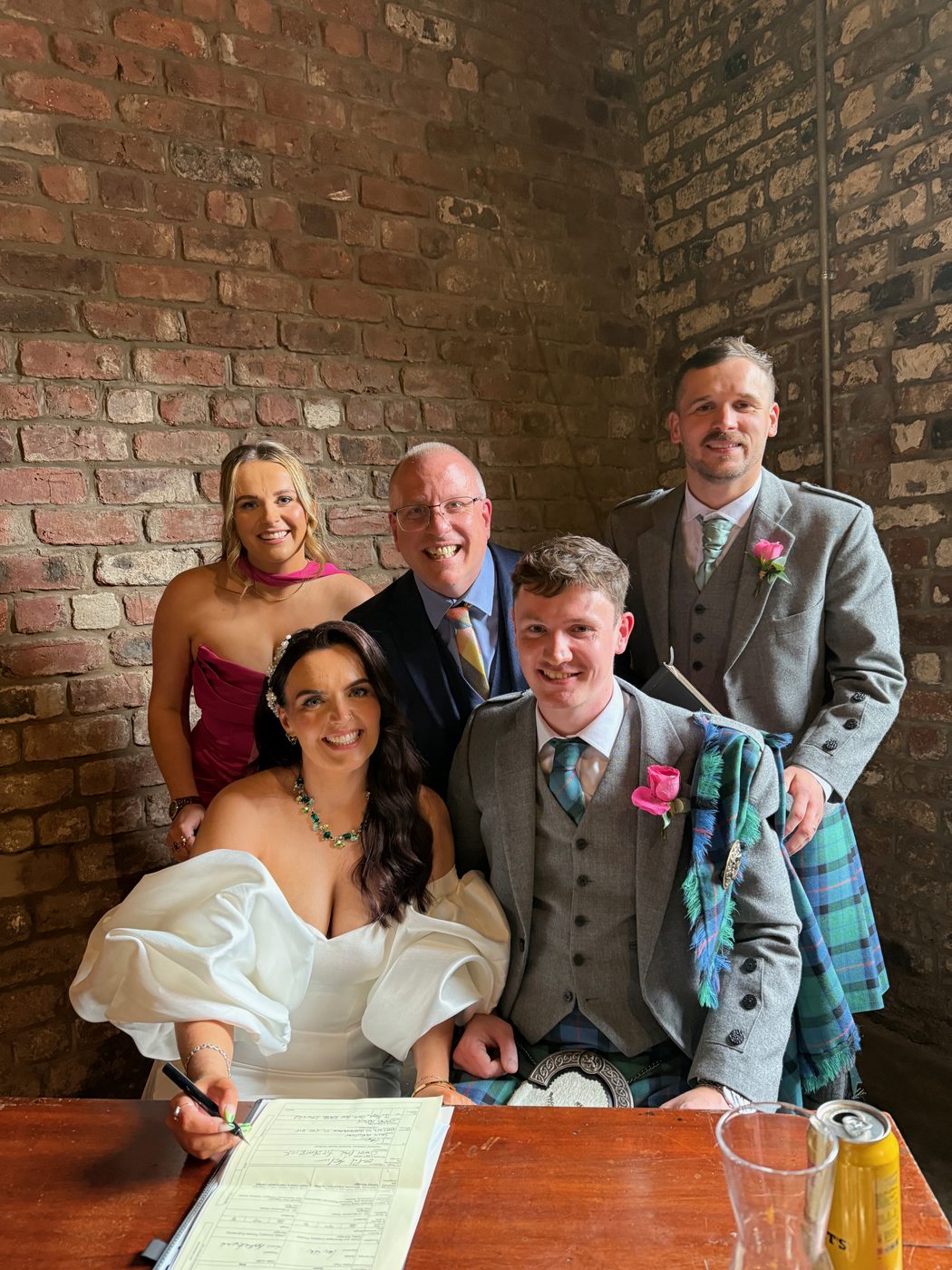
The handfasting itself is symbolic — but here's the good part. In Scotland, a humanist wedding led by an authorised celebrant is fully legally binding, and the handfasting sits inside that legal ceremony. As a Humanist Society Scotland celebrant, I lead the whole thing: your story, your vows, your handfasting, the legal declarations and the signing of the Marriage Schedule. Ancient tradition, modern marriage, one ceremony — no registry office required, anywhere in Scotland from a castle to a clifftop.
Thinking about a handfasting? Tell me your date and I'll tell you exactly how we'd weave one into your ceremony — tartan, ribbons, rope and all.
Check my dateReady to plan yours? I'm a handfasting celebrant covering all of Scotland — the tradition woven into a fully legal humanist wedding.